As an Amazon Associate, we earn from qualifying purchases. Some links on this site are affiliate links at no extra cost to you. Our recommendations are based on thorough research and editorial judgment.

What Is Projector Screen Gain and Why Does It Matter?

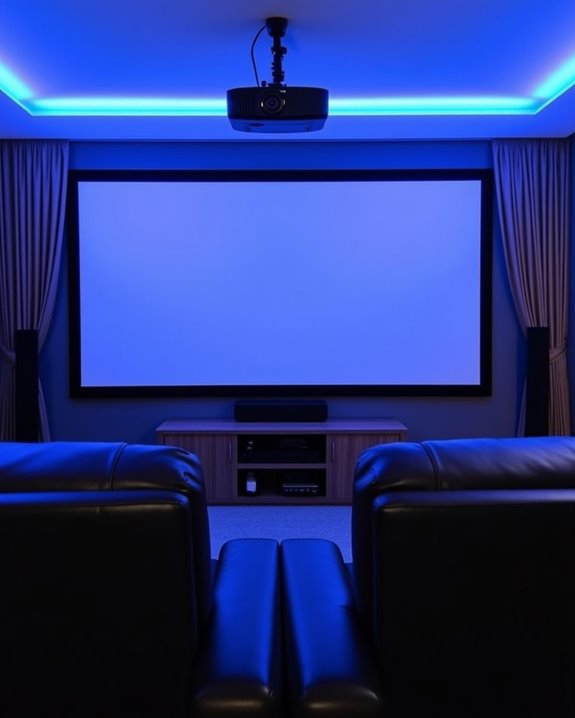
Think of projector screen gain as the lens through which your projector’s light is shaped and directed, determining how bright and clear your images will appear. Screen gain, measured numerically, tells you how much more light a screen reflects compared to a standard matte white surface, directly affecting image brightness and viewing angles, especially in spaces with varying ambient light. Understanding how different gain values interact with your projector’s lumens, room lighting, and audience layout can be critical—yet the science behind it holds even more important details.
Key Takeaways
- Projector screen gain measures how much light a screen reflects compared to a standard reference, directly affecting image brightness.
- Higher gain screens produce brighter images but have narrower viewing angles, while lower gain screens offer wider, more consistent viewing.
- Gain selection impacts color accuracy, hotspot risk, and overall image uniformity, influencing the quality of your viewing experience.
- The ideal screen gain depends on projector brightness, room lighting conditions, and desired seating layout.
- Choosing the correct gain ensures clear, vibrant visuals tailored to your environment and projector capabilities.
Defining Projector Screen Gain
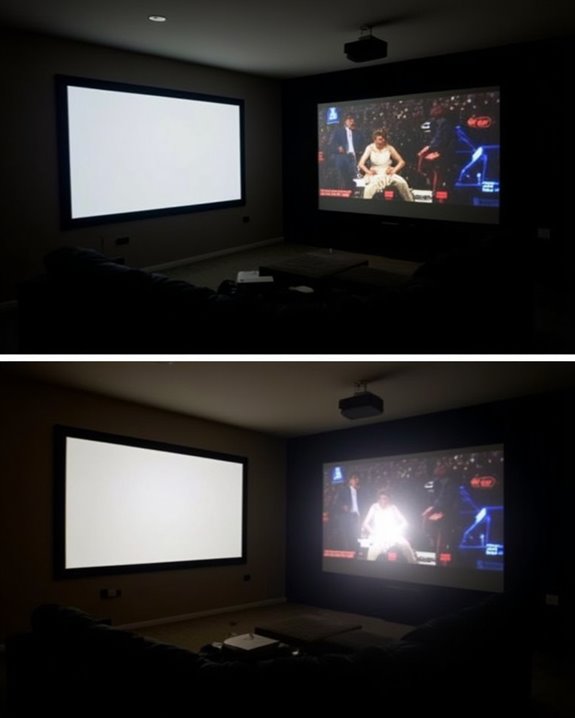
When you’re learning about projector screens, it’s important to understand the concept of screen gain, which measures how much light a screen reflects toward the viewer compared to a standard reference, typically a sheet of magnesium carbonate with a gain value set at 1.0. The screen material and its surface texture play an essential role in determining this gain value, as both factors directly impact how light is reflected or diffused. A higher gain indicates the screen reflects more light back in a specific direction, making the image appear brighter but often narrowing the ideal viewing angle. Conversely, screens with lower gain values scatter light more evenly, resulting in a wider viewing area, though the overall brightness is reduced, making material selection critical for your intended environment. Selecting the appropriate gain is especially important in environments with varying ambient light conditions to optimize image quality. Higher gain screens produce a brighter image at the center, but this increased brightness often comes at the cost of a narrower viewing angle, meaning viewers seated off to the side may see a dimmer image.
How Screen Gain Is Measured
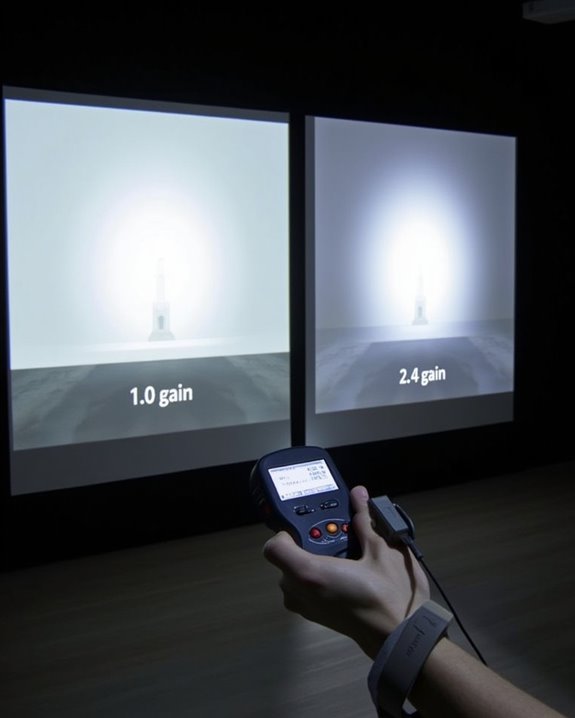
So, how exactly is screen gain measured to guarantee accurate and consistent results? You’ll find that these measurements take place in a controlled, darkened room to eliminate any impact from ambient lighting, and color calibration is essential to ascertain the results are valid for all projection scenarios. A projection lamp shines light nearly perpendicular to a representative screen sample, while precise luminance meters, often set at 5-degree increments horizontally and vertically, record how much light the screen reflects at each angle. The gain is calculated as the ratio of the screen’s luminance to that of a standard Lambertian diffuser, which has a gain of 1. Many modern 4K projectors feature brightness levels measured in ANSI lumens, which directly affect the perceived gain needed for optimal viewing. Screen gain is critical for balancing ambient light, projector lumens, and intended space usage, so accurate measurements help ensure the right screen is chosen for each unique environment. Advanced tools, like goniometers and imaging photometers, allow for detailed angular and spatial mapping, providing a thorough profile under standardized industry protocols.
The Effect of Gain on Image Brightness
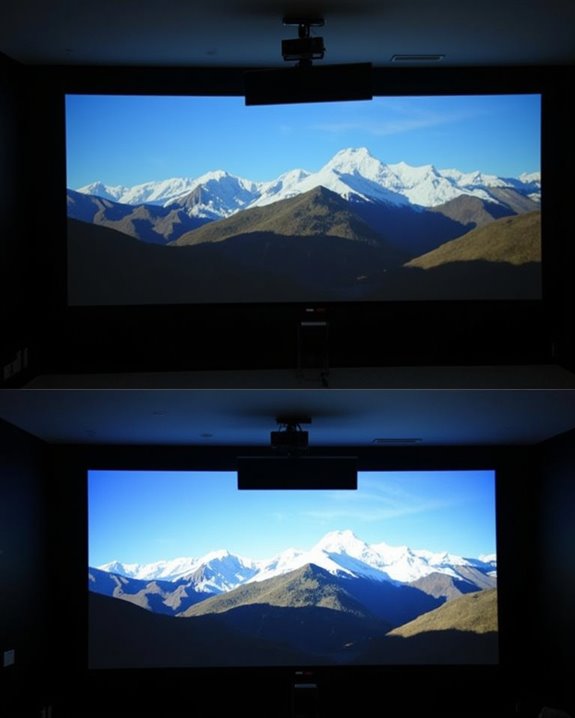
Accurate measurement protocols make it possible to compare projector screens objectively, but screen gain’s real-world impact is most evident in how it affects image brightness during use. When you choose a higher gain screen, you’ll notice the image appears much brighter and more vibrant, especially if your room has significant ambient light or you’re working with a projector that isn’t very bright on its own. However, screens with high gain values can introduce hotspots—localized areas of excessive brightness—which reduce uniformity and affect visual comfort. These hotspots may also compromise color fidelity, causing uneven color saturation or subtle shifts, particularly near the screen’s center or edges. To balance enhanced brightness with consistent image quality, focus on hotspot mitigation and prioritize screens that preserve both brightness and color fidelity. Screen gain influences image brightness and clarity, so selecting the right gain is crucial for achieving the desired viewing experience in your specific environment. Additionally, considering the brightness levels of your projector can help you choose a screen gain that complements your setup effectively.
Recommended Products

★【BRIGHTNESS BOOST】This screen displays significantly brighter images than a normal white screen when viewed from center seats (up to 2.6x gain), and maintains comparable brightness from other angles. Enjoy a brighter image, or use the brightness for a bigger screen! (NOT for UST projectors.)

CONVENIENT TO STORAGE AND CARRY : Compact one-piece,lightweight and folding design. You can fold the projector screen in small size and put it in your backpack or suitcase

Wall Mounted Fixed Frame Projection Screen (Overall Size 63.625" Tall x 109.25" Wide) (Viewing Area 120" Diagonal x 58.875" Tall x 104.5" Wide) No option for Legs or Stands with this product. Recommended for projectors with Native 16:9 Resolution
Viewing Angle and Its Relationship to Gain
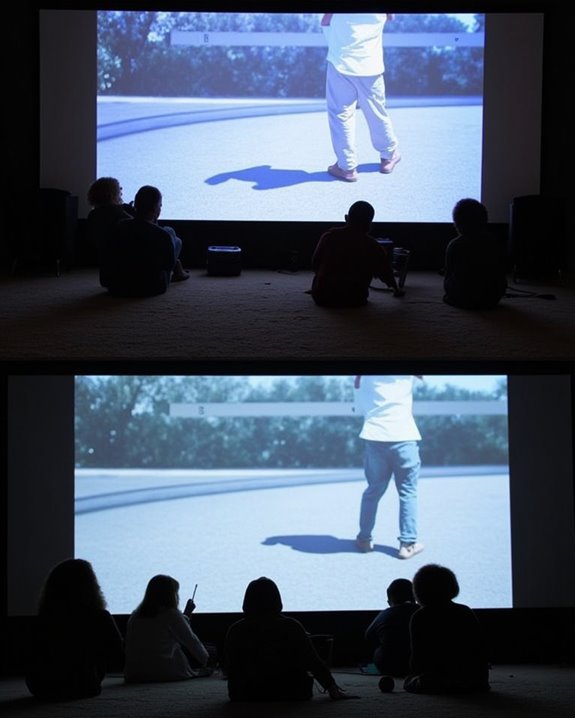
Although projector screen gain is often discussed regarding image brightness, its relationship with viewing angle is just as important for achieving a high-quality visual experience. When you select a screen, the viewing angle determines how far off-center you can sit before brightness and color accuracy begin to degrade. High-gain screens usually provide increased brightness, but their viewing angles are much narrower, meaning viewers seated at the edges might notice dimmer images or color shifts. Conversely, low-gain screens offer wider viewing angles, ensuring more consistent brightness and accurate colors for a larger audience, though with lower peak brightness. Material durability also plays a role, since the longevity and performance of the screen depend on the quality of construction, especially under frequent use or in large venues. In fact, higher gain correlates with a smaller viewing angle, which is why achieving both high gain and wide viewing angles remains a central challenge in modern screen design.
Types of Screen Gain Surfaces
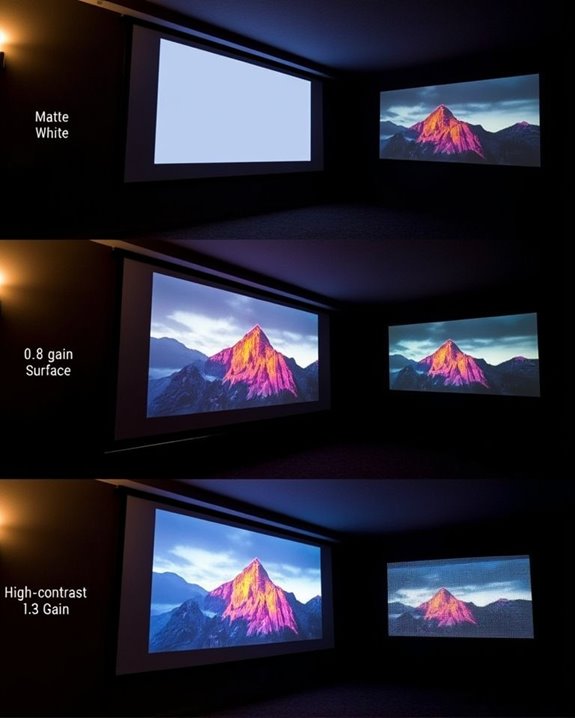
When considering how viewing angle affects your projector setup, it’s just as important to understand the different types of screen gain surfaces available, since these directly influence both brightness and image quality. Screen gain surfaces fall into categories like low gain (0.5-0.9), neutral gain (1.0), and high gain (1.1-2.5), each offering distinct surface textures that impact image reflectivity and color consistency. Low gain screens diffuse light for even brightness and wide viewing angles, while neutral gain surfaces balance brightness and color accuracy, making them suitable for most projectors. High gain screens use smoother textures to boost brightness, but may narrow viewing angles and affect color consistency. Specialized surfaces, such as gray or tinted screens, enhance contrast and black levels, often using advanced materials for tailored performance. In addition, projector compatibility and recommendations play a role in choosing the optimal screen gain surface, since certain projector technologies pair better with specific screen types for improved image quality.
Recommended Products

【Experience Better Contrast and Color】2025 Upgraded 100 inch projection screen with black backing is impervious to light, effectively resisting light sources and eliminating light spots. Improve video playback quality, more helpful for daytime and outdoor use

HOME THEATER LEVEL ENJOYMENT: HYZ projector screen with stand uses cinema-grade material, which can achieve theater-grade 1.5-level gain reflection effect, five-layer preferred material, in order to ensure that the visual experience of the maximum degree of refusal to roll edges, creases. 160° Viewing angle without dead angle viewing, 4K HD equipment, you can enjoy the theater experience at home
HIGH DEFINITION PROJECTION EFFECT from NIERBO canvas material projector screen always gets applause and compliments from everyone who sees it. The 1.6 gain and the 160°wide viewing angle shows a clearer image and more excellent resolution.
Matching Gain to Room Lighting Conditions
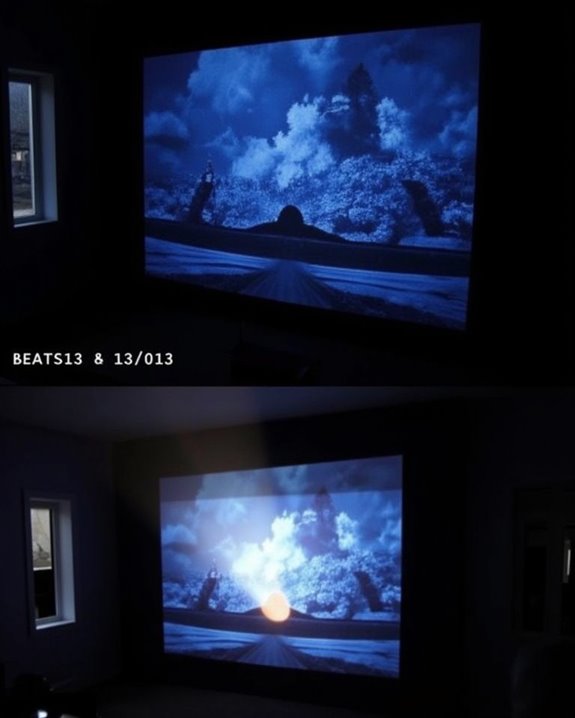
Since the lighting conditions in your room directly impact how well your projector screen performs, it’s essential to match the screen’s gain to the environment where you’ll be watching. If your space has high ambient lighting, you’ll want to choose a screen material with a higher gain—typically between 1.5 and 3.0—to boost image brightness and maintain clarity, even in well-lit or outdoor settings. For dark rooms, a low-gain screen, around 0.6 to 1.3, helps prevent image washout and preserves accurate color representation. When your room’s lighting varies, consider a medium-gain or adjustable screen to balance brightness and color fidelity. Viewing angle also plays a role; wider seating arrangements benefit from lower gain screens for more uniform images across all seats. Always evaluate both ambient lighting and the properties of the screen material to guarantee clear, vibrant images suited to your specific viewing environment.
Recommended Products
1. 【Lightweight & Foldable 16:9 Screen】 Designed for casual indoor and outdoor use. This high-density polyester projection screen offers a wide viewing angle. It is incredibly lightweight and folds compactly to fit in your own backpack, making it the perfect budget-friendly choice for camping, backyard movie nights, or temporary setups.

【Cloth Projection Screen with double layer】 NIERBO newly designed projection screen still uses the traditional polyester cloth material. But it’s designed to be white in the front, black in the back now. This unique technology helps to reduce the influence of ambient light, and improve the picture quality greatly.

【Watch Before Buying】Please read the dimensions carefully and measure the size corresponding to the desired scene before confirming. You can also match the scene according to the specific size, without being limited to the following.
Screen Size, Projector Lumens, and Gain Interplay
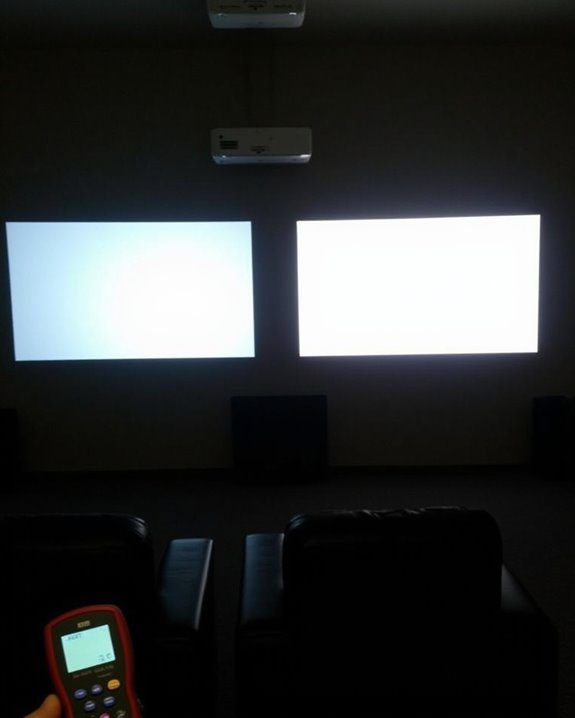
Balancing screen size, projector lumens, and screen gain is essential for achieving the right image brightness and clarity in any projection setup, as each factor directly influences the others. Larger screens disperse light over a wider area, which reduces brightness per square foot (measured in foot-lamberts), so you’ll need either more projector lumens or a higher gain screen to compensate. The total light output, rated in lumens, determines how bright your projected image will be, especially in relation to different projection types and screen dimensions. Screen gain amplifies perceived brightness but can affect color accuracy and viewing angles. Since ambient light in the room can significantly impact the perceived brightness, settings with more light require a projector with higher lumens or a screen with higher gain to maintain image clarity. Calculating the interplay between these variables ensures your chosen setup delivers a clear, vibrant image, regardless of the room’s size, ambient lighting, or projection type.
Recommended Products

Matte White Screen with 1.3 Gain:Provides enhanced brightness and contrast for superior image quality, ensuring vivid and clear visuals.

PREMIUM METERIALS : This projector screen is made of matte white PVC material with a four-layer composite structure. Resists expansion and contraction caused by external temperature and humidity fluctuations, thereby preventing wrinkling
Optimizing Viewing Experience Through Proper Gain Selection
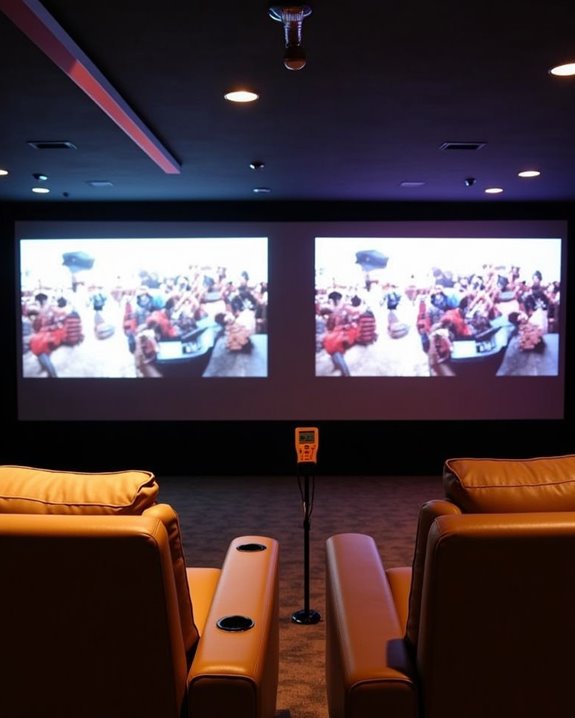
Selecting the right screen gain is a key step in optimizing your viewing experience because it directly determines how bright and vivid your projected image will appear in any environment. When choosing among screen material options, consider the room’s lighting, projector brightness, and your seating arrangement. Higher gain screens, often made from specialized materials, reflect more light, making them ideal for spaces with ambient light, but they may narrow viewing angles. If wide seating is needed, low gain screens provide consistent brightness across more positions. For setups requiring sound to pass through the screen, look for acoustic transparency, which is available in both high and low gain variants. By matching screen gain to your room and usage, you’ll ensure optimal brightness, uniformity, and immersive visuals. Screen gain is measured as a ratio compared to a perfect reflective surface, indicating how efficiently a screen reflects light toward the audience.
Recommended Products

This economical and practical polyester textile material is suitable for DIY production of wooden fixed-frame projection screens below 130 inches in size. Just stretch and fix it on all four sides.
Wall Mounted Fixed Frame Projection Screen (Overall Size 58.75" Tall x 100.75" Wide) (Viewing Area 110" Diagonal x 54" Tall x 96" Wide) No option for Legs or Stands with this product. Recommended for projectors with Native 16:9 Resolution

★【BRIGHTNESS BOOST】This screen displays significantly brighter images than a normal white screen when viewed from center seats (up to 2.6x gain), and maintains comparable brightness from other angles. Enjoy a brighter image, or use the brightness for a bigger screen! (NOT for UST projectors.)
Technical Challenges in Determining Screen Gain
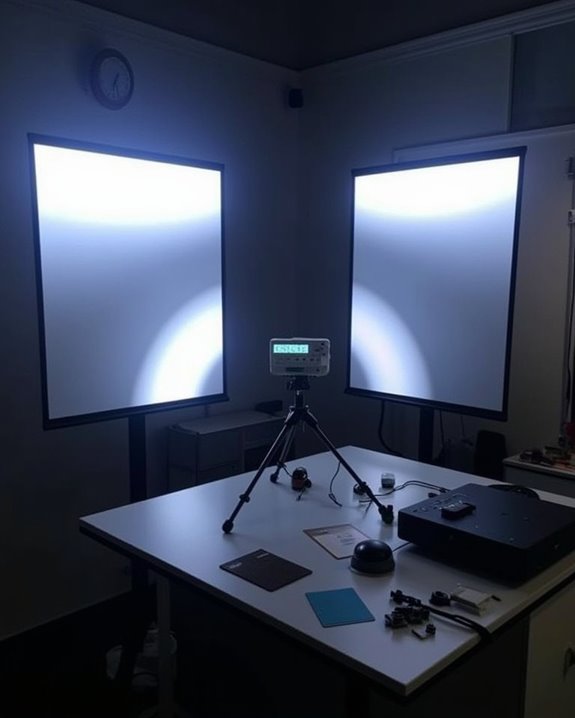
Though screen gain is a crucial factor in achieving the best possible image from your projector, accurately determining it comes with several technical challenges. Measuring screen gain requires understanding how much light a screen reflects at its peak, which is usually measured at the center when viewed head-on. You’ll often rely on manufacturer specifications, but these can vary based on testing methods and may not account for variables like color accuracy and material durability. Screen size also impacts gain, as larger surfaces can cause low-gain screens to appear dimmer, especially if your projector isn’t bright enough. Additionally, higher gain screens can create uneven brightness and “hot spots,” especially when viewed from wider angles. Professional guidance and a solid grasp of gain tables are recommended for ideal results. Regular maintenance and cleaning of the projector’s optical components can also influence perceived screen gain by maximizing the amount of light reaching the screen.
Frequently Asked Questions
Can Projector Screen Gain Affect 3D or HDR Video Performance?
Did you know 3D content needs up to twice the screen brightness of standard video? If you pick the wrong gain, you’ll lose image contrast and vibrancy in both 3D and HDR, impacting your viewing experience.
How Does Screen Gain Impact Long-Term Screen Durability?
When you choose a high-gain screen, you’re trading some screen longevity and material durability for brightness. These screens can be more prone to wear, scratching, and environmental damage, while lower-gain options usually last longer and handle stress better.
Are There Portable Screens With Adjustable Gain?
You won’t typically find portable options with truly adjustable gain—most portable screens have fixed gain based on their material. While you’ll get adjustable features like height or aspect ratio, gain remains constant for each screen model.
Does Screen Gain Influence Projector Lamp Lifespan?
Picture your projector lamp glowing behind a reflective screen—higher screen gain means brighter reflection at lower lamp power, which can extend lamp lifespan. But, narrow viewing angles may limit where you enjoy crisp, vibrant images.
Can Screen Gain Be Changed After Installation?
You can’t make permanent gain modifications to your screen after installation since gain is inherent to the material. However, some rare adjustable gain screens exist. Otherwise, you’d have to replace the screen to change its gain.